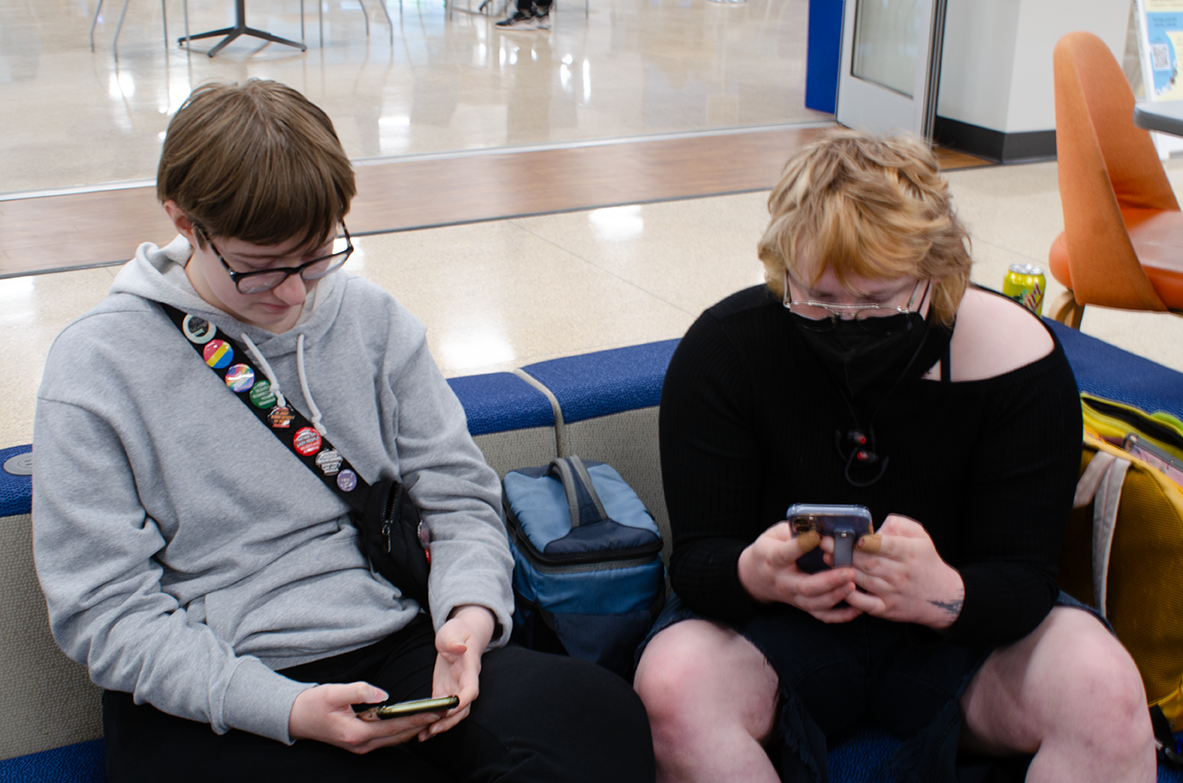
Social media, the defining feature of everyday life for billions worldwide. While some apps are starting to fall off for younger users, others may be continuing to rise.
Platforms like Facebook are decreasing in popularity for teenagers and young adults, according to findings from Pew Research Center in 2022. Certain other aspects of social media now, particularly the rampant appearances of AI, might be turning more users off. Sophia Ogle, first-year student at SFCC, says they use social media less than they did when it was first acquired.
“I use it a lot less”, said Ogle. “There’s too much AI, and that angers us because we’re art majors.”
Ogle says AI could be contributing to social media losing its grip in some ways, including getting in the way of connecting with real users and people.
“It’s more difficult to deal with because more are using AI”, said Ogle. “So I think it’s going under, personally.”
Many young people are also expressing a desire for community. After COVID-19 sent the world into lockdown, apps like TikTok skyrocketed and new users began posting in search of friends and like-mindedness.
Post-2020, many have felt disconnected from their communities.
“During COVID, it was cool, because you could still stay connected”, said Simpson, a first-year student at SFCC. “Now that we’re hopefully moving toward a pandemic-free world, there’s a lot of discourse. People want community, but so many people are also on their phones.”
On the flip side, however, there may be positives to a digital world in our hands.
“I have pros and cons”, said Simpson. “Pros is everyone is staying connected.”
According to Pew Research, 57% of teens have met new friends online, while 29% say they’ve made at least five new friends this way. Additionally, a survey conducted by Bumble in 2023—a dating and friendship-finding app—found that 66% of Gen Z respondents report having met their friends online.
However, Jonathan Haidt, social psychologist, author, and holder of the Thomas Cooley Professorship of Ethical Leadership at New York University’s Stern School of Business, argues that negative consequences outweigh positive outcomes. He believes that smartphones, particularly for children and young adults, negatively impact mental well-being and ability to socialize with others.
“Smartphones don’t just pull students away from schoolwork; they pull them away from one another too”, Haidt writes in a research article posted to The Atlantic in 2023.
Others agree that children may feel the negative consequences worse than more developed minds. Young adult Magnolia Rioux, 22, says that as an adult, she’s able to navigate social platforms better, but sees the negative consequences it can have on young children.
“Now that I’ve established myself, I know how to use it better,” said Rioux. “But I’ve seen it affect other people, like my little sister. People on the internet are always only showing the good stuff, and I think it sets an unreasonable expectation.”
According to research conducted by Statista, 61.4%—or 4.95 billion people worldwide—-are on social media. Millennials are taking the reins on this number, with Gen Z being a close second. Although this remains the case, eMarketer concludes that by 2027, millennial users on social platforms will fall flat, while Gen Z will only continue to grow as time goes on.
For questions of comments related to this story, contact the author at: sfcc.gus.dinsmore@gmail.com
