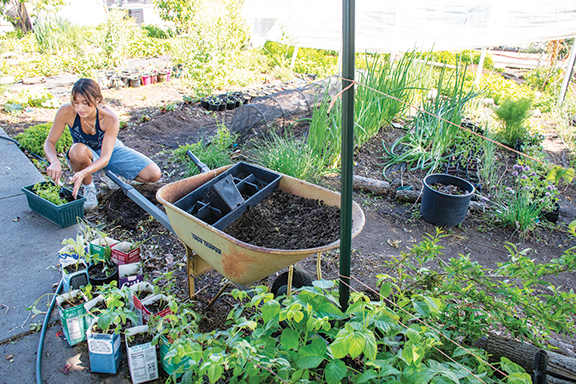
SFCC’s Environmental Club focuses on sustainability, community development and off-campus partnerships.
The club has formed and fractured many times over the course of its history. The current iteration has been around for at least seven years. In that time, the club has provided a space on campus for students to learn about and interact with the environment. Michelle Pearson, the club’s current co-advisor, believes the community garden is central to the club’s mission.
“The garden is funded by the environmental club,” Pearson said. “The club makes the choices about what’s going in the garden.”
The garden itself is run by volunteers, work study students, and club members. Its purpose is not solely for growing produce; it is also commonly used by students to do agricultural science studies.
“Students are doing projects and usually doing a lot of data collections,” Pearson said. “So we can actually keep track of what we’re growing, how much we’ve grown and harvesting stuff.”
The garden may eventually be expanded Club President Gabriella Hultman said the club would benefit from expanding the garden space.
“The old art building is going to be torn down and we are potentially going to be using that for garden space,” Hultman said.
This is only one of many projects and activities in which the club engages. As part of their goal to clean up the campus, the club does annual spring cleanups of the centennial trail near the SFCC campus.
“We do trail cleanups, and our spring cleanup yielded over 100 pounds of trash on the edge of campus”, Pearson said, “It’s a strange thing. We all grow up knowing this is our planet. It’s the only one we have.”
SFCC’s Environmental Club also prioritizes off campus partnerships with groups such as Spokane Zero Waste. They are a community organization whose stated goal is to create a waste-free Spokane through education and community events. Zero waste helped with the mending event the club puts on, a community event for salvaging old clothes destined for the bin.
“The biggest event we had this year was our Mend N’ Swap,” said Hultman. “You bring in the clothes to be repaired. There would be volunteers and no organisation, but we do work with Zero Waste. [They] take in clothing such as bags and jackets that need to be repaired and repair them so they don’t end up in the trash.”