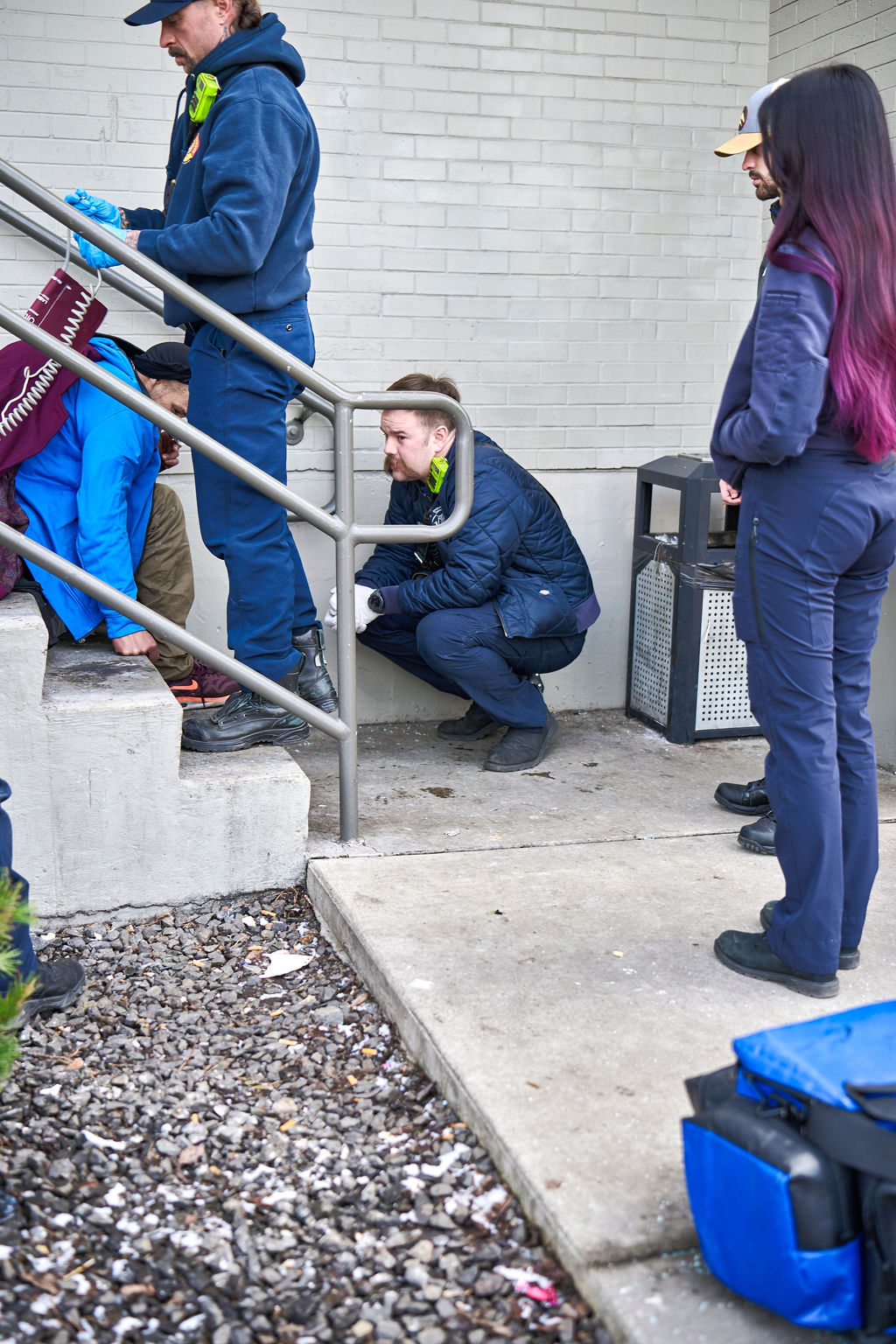
Everyday another Spokane family will wake up to the same phone call that has become increasingly common across the Inland Northwest: a son unconscious in a parking lot; a daughter revived with Narcan; a parent lost to fentanyl before help could arrive. Spokane parents, like Anne Raven, become progressively nervous for their children to run into drugs unintentionally.
“I have a daughter, and I worry that someone could give her a pill someday,” Raven said. “She isn’t meaning to try fentanyl. It only takes one wrong pill.”
As opioid overdoses surge across Spokane, the crisis has become a force unraveling lives across the city. But amid the devastation, Spokane is beginning to fight back with a growing push for change.
In 2024 alone, Spokane County recorded roughly 346 overdose deaths, with fentanyl detected in nearly 80 percent of accidental overdoses, a stupendous increase from just 80 total overdose deaths in 2019.
In addition to being a mother, Anne Raven serves as a Battalion Chief for the Spokane Fire Department, where she helped implement a behavioral response team to address the crisis.
“We have a unit that is part of the 911 dispatch system,” Raven said. “We have one who is a licensed mental health counselor and another who is a substance use disorder professional. They are single role units meaning they will not fight fire. They are 100 percent dedicated to the behavioral response unit.”
Currently on a day-to-day, these behavioral response units arrive on scene to assist individuals experiencing mental health or substance use crises. As of 2024, these units have begun carrying Buprenorphine to ensure the safest immediate recovery for these individuals.
Spokane is the first in the state to introduce Buprenorphine Suboxone, a partial opioid agonist that binds to brain receptors to reduce cravings and withdrawal symptoms.
“When we first started this, the awareness of how life-saving and life protecting Buprenorphine is wasn’t as clear,” Raven said. “But now, it is clear that it is. It cuts the mortality rate in half for one to three days.”
According to Daily Dispatch, the impact of these specialized units is already showing up in local data. Following the expansion of the behavioral response efforts, Spokane County has seen a 29% drop in monthly suspected opioid overdoses, signaling a break in the peak cycle of the crisis.
Raven experiences first-hand how these individuals struggle and how they recover. Since carrying Buprenorphine, she has seen a change in the process that will continue to help those who need it and eliminate the uneasy feeling that someone might go back to where they started.
“The only other way to relieve their withdrawal, which is terrible, is to go get more,” she said. “But now we’re seeing less of it, where you’re just going back out on an overdose for the same person you just saved from an overdose. That is kind of soul crushing.”
“To keep running on the same people over and over and over again with the same type of call and seeing they’re never getting the appropriate care and for whatever reason, they’re falling through the gaps in service… our current process is better for those that don’t know they’re going to need us.”
Pioneer Human Services, a residential treatment center in Spokane that provides intensive inpatient treatment, has been central to aiding the substance abuse crisis. In his role as Director of Workforce Development and Community Services, Darin Christensen looks at the community through a lens of growth and recovery.
“We have a variety of different programs and services intended to provide for people,” Christensen said. “Pioneer has the opportunity to take resources and specialize them to the needs of an individual who has been impacted by the system.”
Pioneer Human Services expands their credibility through the professionals they hire. In order to promise a smooth recovery process, Pioneer makes sure that they focus on personal experience before degrees and resume statistics. This ensures that outreach workers share a cultural connection with patients, allowing them to navigate situations with deep cultural competence and respect.
Christensen shares his perspective on why it is important to have those experiences rather than have just learned about them through schooling.
“I can’t teach you how to understand the process of personal lived experience,” he said. “They either have the experience of having gone through recovery, having gone through some mental health crises, et cetera., or they don’t. I can’t teach you how to relate to these people.”
While public attention often focuses on the initial crisis of detox, Christensen emphasizes that the true battle against addiction is a quiet, relentless routine. It is a process where success is measured not in years, but in twenty-four-hour increments.
“One thing that they need is continued support so that their recovery is maintained,” he said. “Because for an individual in recovery, it’s about day-today: waking up every day and deciding ‘I’m not going to relapse. Today I’m not going to.'”
When the margin for error is that slim, commitment to funding and community programs cannot be temporary. If the battle is fought day-to-day, then that support must be present day-to-day.