The Spokane River has been the heart and lifeblood of the region’s inhabitants, from the many native tribes that thrived on the river, to the first settlers of Spokane in Peaceful Valley. Through the years and decades that Spokane has grown, there has been a growing concern for the quality and health of the river.
In the 1970s, the city of Spokane cracked down on industrial pollution and the release of polychlorinated biphenyls. In more recent years, there have been issues with stormwater and sewage leaking out into the river.
The Spokane Riverkeepers is one of the local organizations working to keep our rivers clear of trash and spread awareness about the importance of our natural waterways. Jule Schultz, the Waterkeeper at the Spokane Riverkeepers, has been a member of this community for over a decade.
“We are a citizens group, an arm of this community that wants this river clean,” Schultz said. “The more people using the river and connecting with the river and the more we grow, the river grows in turn, it gets cleaner and healthier.”
This earth day, the Riverkeepers had a turnout of around 600 people who were able to remove five tons of trash from the river.
“We cleaned up High Bridge and Peoples Park; there was a huge outpouring of support there,” Schultz said. “Thats really important to us, it shows both the city and the public how much people love the river, and that is able to communicate much more than ‘we pick up trash.’ It’s that we love our river and will show up for our river and donate time to the river.”
Many of the water quality issues the river faces come from nonpoint source pollution, which includes runoff from neighborhoods, roads, and farms. The drop in the river’s water levels categorized by cubic feet per second is another issue that is a growing problem.
“The biggest challenges in our river right now are two things,” Schultz said. “Number one is nonpoint source pollution, that being runoff that goes into our rivers, especially from rural areas.”
The Spokane aquifer covers a large area of around 370 square miles, from the Pend Oreille Lake to a little west of Spokane. The river and surrounding lakes are all connected through this aquifer.
“The second is a river flow issue. Schultz said.Our river went dry last year for the 1st time in recorded history,” “We don’t know why this happened, but we do know that we use way too much water in the city of Spokane.
“Part of that is climate change,” Schultz said. “In the 1900s we used to have a minimum flow of 2000 CFS, now our river is at 700 CFS. That’s because less snow is melting off earlier and it’s very clear what’s happening there.”
Last year, parts of the Spokane river saw an alarming drop in water levels. The river dipped below Spokane City’s tolerable levels of 1,000 CFS.
Another member of the Riverkeepers, Katelyn Scott, the Water Protector, speaks on the topic of lowering water levels.
“Right now we are pretty sure that it happened because of climate change, though we’re going to be studying that more in the summer with Spokane Community College and the water resources department,” Scott said. “In 2021, we saw the same if not lower flows coming out of Post Falls, there was still water in the river in that reach but this last year for whatever reason there wasn’t.”
The Riverkeepers plan to work alongside the Water Resources Department and the Spokane Colleges to figure out the issue and find a solution so that the river is able to flow properly so that the city and wildlife can be sustained.
“The only thing that has changed is the water and air temperature,” Scott said. “Everything else has pretty much been the same.”
Though with less snow on the mountains, the River Keepers suspect that the river will run dry once again this year. To combat concerns with Spokane’s water usage, the city of Spokane passed a water ordinance in 2021, to restrict water usage which is active annually through June 1 to Oct. 1. During this time, the city asks that outdoor water usage is not used between 10 a.m. and 6 p.m. along with limiting landscape irrigation to four or less days a week. During this time, if water levels drop below 1,000 CFS the city asks to limit irrigation to two days a week.
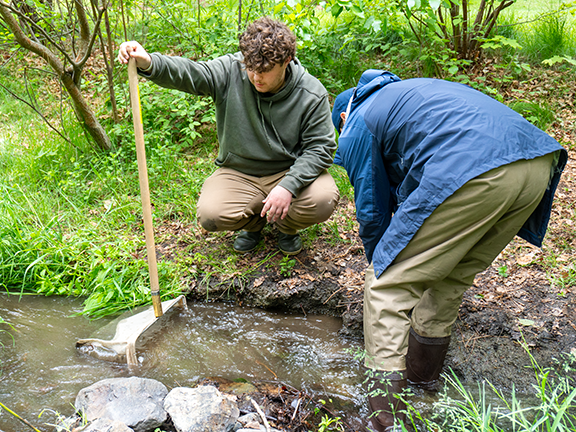
There are signs that the water in the Spokane area may be getting healthier. In the Finch Arboretum stream the River Keepers ran tests on the macro-invertebrates within the stream. Donavon Vitale, a graduate from Cornell University with a Masters of Science and Geoscience, came from New York for the Society for Freshwater Science’s annual meeting.
“We are looking at the diversity in the macro invertebrates, and some species are more resistant to environmental change than others.” Vitale said. “Ultimately what we found here today is that there is a wide range of macro invertebrates present, so we are able to say this is a good healthy stream system.”
The River Keepers and their many volunteers have been working to get the river clean and find solutions to ongoing problems, they hope that their work will inspire others to respect the river and make it a place everyone can enjoy.
“This is a time of reconnection to the river,” Schultz said. “And we’re doing that by creating a healthy and safer river.”
