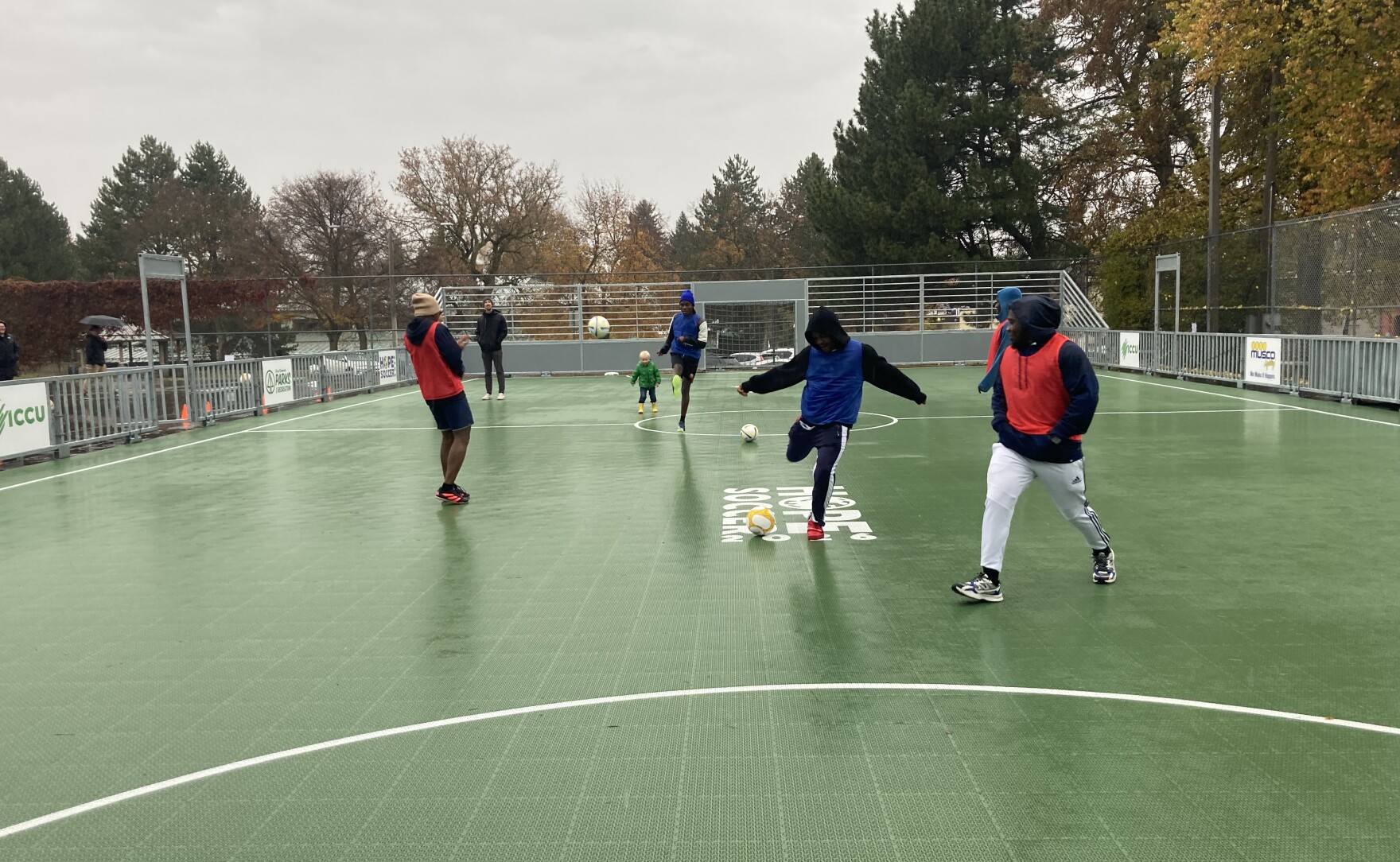
Hope Soccer began from the desire to open spaces for all people to play soccer for free. To accomplish this goal, the non-profit organization is building futsal fields in Spokane neighborhoods with help from Spokane Parks and Recreation.
According to the Union of European Football Association’s website: “Futsal (played on a small field called a mini-pitch) is the FIFA-recognised form of small-sided indoor football. It is played between two teams who each have five players on the pitch at any one time, with rolling substitutes and a smaller ball than soccer that is harder and less bouncy.”
The Spokane project was founded by Gabriel Mwamba and Likius Hafeni. They believe that creating spaces for the youth will spark change in the community.
Staff member Emily Taylor summarizes how the team views soccer.
“At Hope Soccer 2026, we believe soccer is more than a game; it’s a catalyst for change,” Taylor said.
Mwamba grew up in Zambia where it seemed impossible for him to not play soccer.
“There were two things in my life that saved me: soccer and church, ” Mwamba said. “When my dad divorced my mom it was a very dark time. Sometimes I just wanted to be in a room alone. But I found the soccer field to be a place where I felt acceptance. I want to create the outlet that I had as a kid for [Spokane’s youth].”
So far, the organization has collaborated with the city to build one futsal field, built in November of 2025. Since then, Hope soccer has utilized the field to present the community with mental health workshops and pickup games for all ages.
Board member and volunteer, Micheal Wilson leads the mental health workshops for the organization.
“We want the workshops to be shorter and more structured,” Wilson said. “We want to partner with a mental health institution, someone who teaches that for a living, so the kids are provided with structure.”
Wilson has experienced the Spokane soccer culture first hand, with his own children going through the club soccer process. He speaks about meeting Mwamba and being inspired by his aspirations.
“At this point in time, my daughter is playing for the shadow [soccer club], Wilson said. “She just wants more and more.
“I love it, but it’s expensive. We need more financially respectful options in Spokane. We need streetball so badly. Finding Gabriel at this time was perfect, everything fell into place at a magical time.”
Mwamba said he looks forward to the future as he plans to partner with the city to build a mini-pitch in every neighborhood he can. He focuses primarily on supporting the underprivileged areas, however, he wants to build in all areas of Spokane.
“Our next project will be building another mini-pitch at Cannon Park; that is in progress as I am speaking to you,” Mwamba said. “We want everything to be accessible and free.”
Mwamba goes on to introduce his upcoming plans for the mental health workshops and mentorships.
“In April, we will be having a lot of new programs open up,” he said. “I want to hold them at the mini-pitches so they don’t have to travel.
“We want to incorporate the concepts learned in Africa. I helped mentor many of the kids on the street and I want to do the same thing with this.”